
What AfroTech 2026 taught me about jumping in before I'm ready.
I walked into AfroTech this year with a plan. A color-coded plan. Seven stages, a schedule app, a phone at 100%, and a firm intention to "absorb everything."
By lunch on day one I had absorbed a lot of coffee and exactly one idea, and it wasn't about AI. It was about Double Dutch.
The Ropes Don't Stop for You
This was AfroTech's tenth year. Morgan DeBaun opened the keynote by reminding us that the first one, back in 2016, was about 650 people in a San Francisco mall, because a mall was what the budget allowed. This year the main room alone had more than 5,000 seats. Sitting in that room does something to you. It's very hard to believe the "there aren't enough of us in tech" story when you can't find an empty chair.
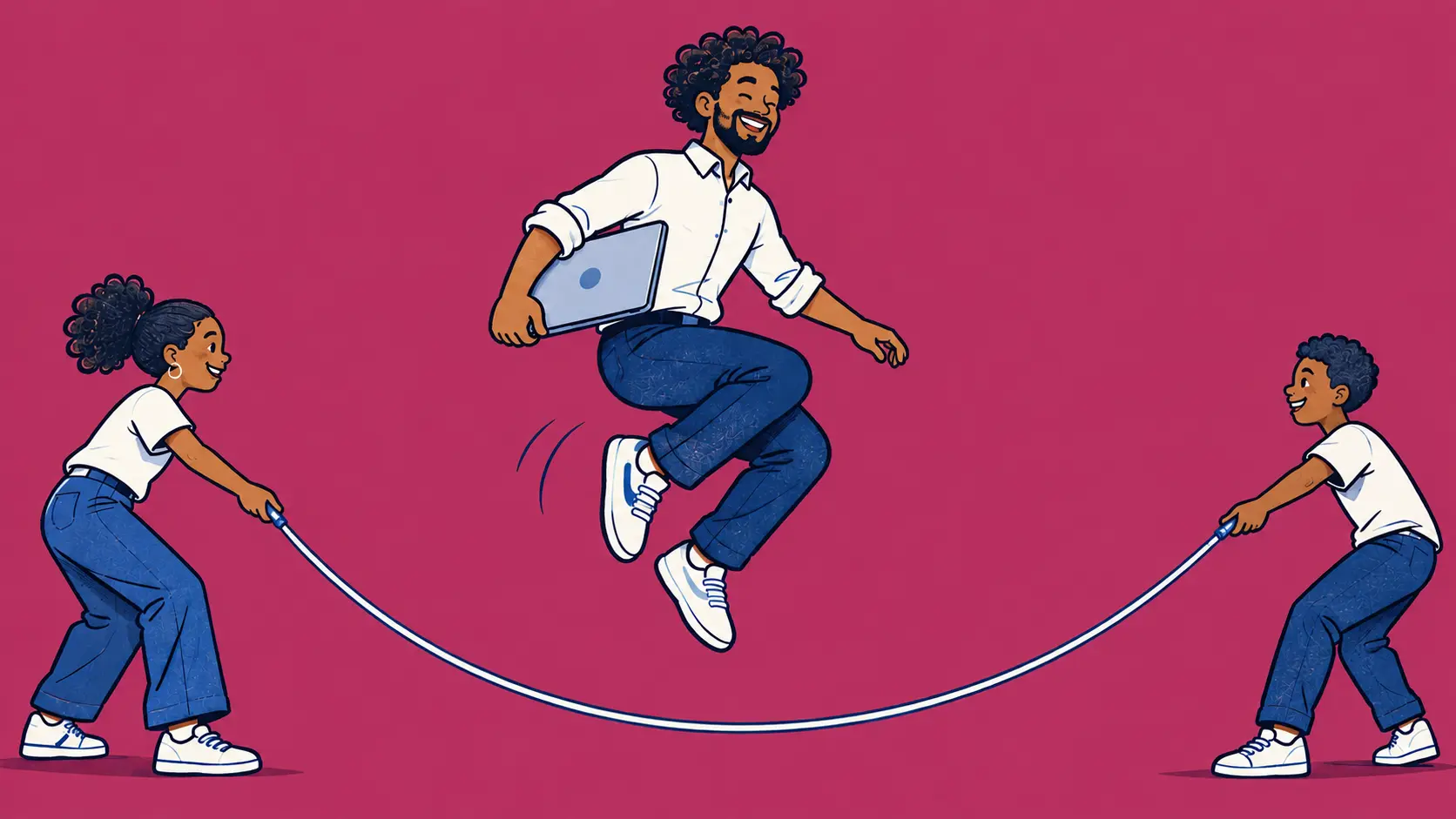
Then she told a story about learning Double Dutch as a kid, standing on the sidelines of a new school, trying to figure out when to jump in. Her point was simple: the ropes don't stop for you. Nobody pauses the game so you can step in comfortably. If you wait for the ropes to slow down, you'll be standing on the sidewalk all day.
I felt personally called out, because at times, I am a professional sidewalk-stander. My version of waiting for the ropes to slow down is called "doing a little more research first." I have opened more "getting started" tabs for AI tools than I have actually gotten started with. I have bookmarked things to read "when things calm down," as if things have ever calmed down.
She also said you'll probably catch the rope on your ankles the first few times, and that's fine. That's the part I keep coming back to. Catching the rope isn't failure. It's the price of admission.
Everybody Was Talking About AI (But Not the Way I Expected)
Nearly every session I went to was about AI. I braced myself for a week of demos where a chatbot books a flight and everyone claps.
That's not what happened. Talk after talk landed on the same, slightly uncomfortable conclusion: the models are becoming a commodity. The thing that decides who wins isn't which model you picked. It's the people, the data, the judgment, and the ownership around it.
A few moments stuck with me:
Demos are easy. Products are hard. Dr. Olukunle Owolabi from Meta pointed out that roughly 80% of AI projects fail, and mostly not because the tech is weak. They fail because nobody really understood the problem or picked the right way to measure success. That one stung a little, because "let's just try it and see" is a sentence I have said out loud in a meeting. More than once.
Hallucination is often a context problem. The Capital One panel made the case that a lot of what we call the model "making things up" is really the model not having the right data. Garbage in, garbage out, now with better grammar.
AI amplifies whatever is already there. Good habits get bigger. Bottlenecks also get bigger. If your process was a mess before, congratulations, it's now a faster mess. They also said that counting commits and PRs is basically meaningless now. What matters is how long it takes to get something into production and how many defects show up once it's there. I'd love to say I've never been impressed by my own commit graph. I'd be lying.
Idle compute is the real cost. Nicole Murray from NVIDIA walked through how most of an AI stack is actually CPU work, and how a lot of expensive GPUs sit around doing nothing. Her advice was basically: before you ask for a bigger machine, check if you're using the one you have. Which, honestly, is also good advice for my gym membership.
Accountability over hype. Dr. Timnit Gebru brought the room back to earth. "AI" is mostly a marketing term, and behind it are people, all the way down. People labeling data, people whose data was scraped, people who get affected when a system gets it wrong. Talking about superintelligence, she argued, is a great way for companies to dodge responsibility for the very real problems happening right now.
The Part Where AI Was Supposed to Give Us Time Back
Here's the part that hit closest to home.
One of the Capital One panelists admitted he burned himself out running about a dozen agents at once while building his own system. Not because the agents were bad. Because he was the bottleneck, switching context between all of them like a very tired air traffic controller.
AI was supposed to give us time back. For a lot of people in that room, it did the opposite. Faster tools create faster expectations, and suddenly you're managing five conversations with five assistants and you can't remember which one you told to rename the variables.
I laughed when he said it. Then I thought about how many terminal tabs I had open back at home, each one with an AI helper waiting patiently for me to come back. I stopped laughing.
The advice from that panel was refreshingly human: small, focused teams. Psychological safety. Leaders who actually use the tools themselves instead of just asking for "more AI" in a slide deck. And watching your own cognitive load the way you'd watch a server's CPU.
What I'm Actually Taking Home
I came home with a lot of notes. Way too many notes. But if I'm honest, here's what I'm going to try to do differently:
- Define the problem before I build. What does good look like? What's acceptable? What's a hard no? If I can't answer those, I'm not ready to open the IDE.
- Keep the boring stuff boring. Deterministic, predictable systems for the clean, high-stakes paths. Agents only at the messy edges, with tight boundaries, and with them telling me what they assumed.
- Treat data as part of the AI work, not a separate project somebody else will get to later.
- Test before I trust. Build evaluations before shipping, and check them against what a real person would say.
- Measure outcomes, not activity. Time to production. Defects in production. Not how many prompts I sent this week.
- Fewer tabs. I'm writing this one down mostly so I feel guilty about it later.
Turn the Rope
The last thing Morgan said is the one I'd tattoo on my forearm if I were braver: getting hired at companies was never the finish line. Owning things, building things, and helping each other is.
Double Dutch needs at least three people. Two to turn and one to jump. The turners slow down or speed up to help the jumper get in. Once you land, you're supposed to pick up the rope and turn it for the next person.
So that's my homework. Jump in before I feel ready. Expect to catch the rope on my ankles. And once I find my rhythm, turn it for someone else.